
For Stablecoins
Grow Liquidity & Adoption
New stablecoins face a bootstrapping problem: liquidity providers need trading fees to justify their capital, but fees require volume, and volume requires liquidity. Break the cycle with targeted volume generation.
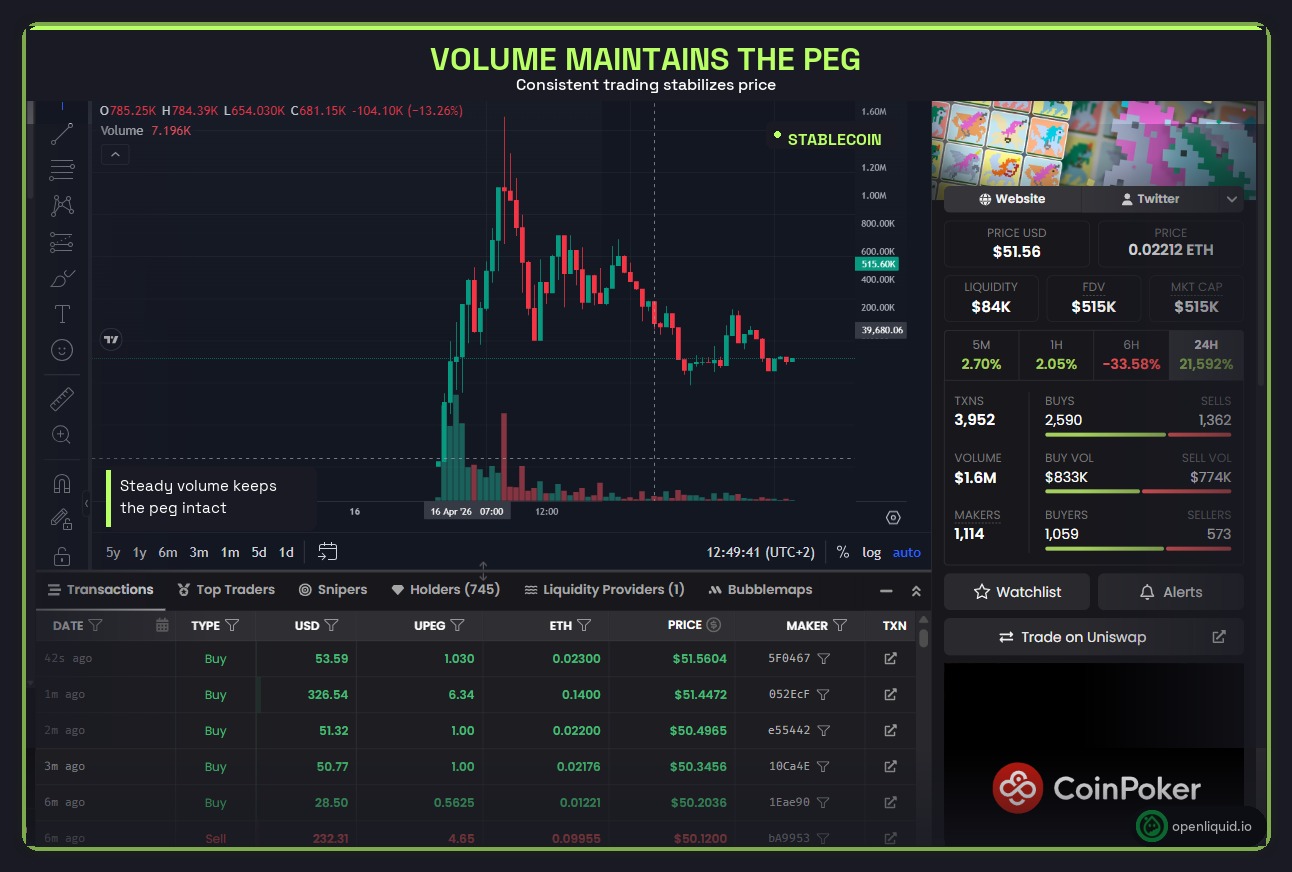
OpenLiquid helps new stablecoin projects bootstrap trading activity to attract liquidity providers and demonstrate market adoption. Stablecoin pairs on DEXs generate LP fees proportional to volume, and OpenLiquid creates the transaction flow that makes providing liquidity profitable for LPs, starting the positive flywheel toward sustainable TVL growth.
Why Stablecoins Need Volume
Volume generation creates the fee revenue that attracts LPs, starting the positive flywheel that grows your stablecoin's TVL and adoption.
New stablecoins struggle to gain TVL
New stablecoins compete against USDT, USDC, and DAI for liquidity provider capital. LPs allocate to pools that generate the most fees, which means your stablecoin needs meaningful trading volume to attract any LP capital at all. Without it, TVL stays near zero.
LPs need volume to earn fees
Liquidity providers earn fees proportional to trading volume. If your stablecoin pair generates $100/day in volume, LPs earn almost nothing. They move their capital to pools where the returns justify the opportunity cost and smart contract risk. You need thousands in daily volume to attract even small LPs.
Without volume, no one adds liquidity
Without liquidity, no one can trade your stablecoin in meaningful size. Without traders, there is no volume. Without volume, there are no LP fees. Without fees, there are no LPs. This circular dependency is the primary failure mode for new stablecoin projects.
Hard to get DEX integrations without activity
DEXs prioritize stablecoins with existing volume for default pairs, routing, and UI placement. Low-volume stablecoins get relegated to obscure pool lists that most traders never find. Breaking through this gatekeeping requires demonstrating consistent trading activity.
How OpenLiquid Helps Stablecoins
A step-by-step approach to building sustainable trading activity.
OpenLiquid creates real on-chain trades through your stablecoin liquidity pools. These trades generate LP fees that are visible to potential liquidity providers. Even modest volume — $10,000-50,000 daily — produces enough fees to attract initial LP interest on most chains.
As fee revenue becomes visible on analytics platforms, yield-seeking LPs begin adding capital to your stablecoin pairs. Deeper liquidity reduces slippage, which makes your stablecoin more practical for real-world use cases.
Consistent volume and growing TVL make your stablecoin eligible for DEX default pairs, aggregator routing, and DeFi protocol integrations. Each integration creates new demand for your stablecoin, accelerating organic volume growth.
With deeper liquidity and broader integrations, organic trading volume grows to a level where LP fee revenue sustains the liquidity base without ongoing volume generation. Most stablecoin projects reach this point when TVL exceeds $1-5 million.
Recommended Setup
Suggested volume configurations for stablecoins at different stages.
Bootstrap
$3,000
Fee: $30
Generates initial fee-producing volume for 7-14 days. Suitable for demonstrating LP revenue potential on a single chain and DEX.
LP Attraction
$10,000
Fee: $100
Recommended for new stablecoins targeting their first $500K in TVL. Sustains 30 days of consistent volume across 1-2 primary trading pairs.
Scale
$50,000+
Fee: $500+
For stablecoin protocols targeting $5M+ in TVL and multi-chain deployment. Covers 60-90 day campaigns across multiple chains and DEXs.
Frequently Asked Questions
Stablecoin volume generation is not about price movement — it is about creating the trading fees that attract liquidity providers. LPs choose pools based on fee APR, and volume is the sole driver of LP fee revenue. More volume means better LP returns, which attracts more liquidity, which improves your stablecoin's usability.
On most DEXs, daily volume of $10,000-50,000 generates enough fees to produce competitive APRs for LPs, especially in concentrated liquidity positions. On Uniswap V3 or Aerodrome, even moderate volume concentrated around the $1 peg produces meaningful returns for LPs who set tight ranges.
Yes. Volume generation is especially valuable for algorithmic stablecoins that need trading activity to demonstrate peg stability. Active trading around the $1 mark shows potential users and LPs that the peg mechanism works under real market conditions.
Timeline depends on your stablecoin's use cases and integrations, but most projects that combine volume generation with active business development reach self-sustaining TVL ($1-5M) within 60-120 days. The key milestone is getting integrated as a routing pair on major DEX aggregators, which creates continuous organic demand.