
Tools
Crypto Volume Bot — Generate On-Chain Trading Volume
Generate organic-looking trading volume across 12 chains and 21 DEXs. Advanced anti-MEV smart contracts and multi-wallet rotation — all from Telegram. Flat 1% fee, no subscriptions.
🌱 Organic volume
Trades spread across up to 300 unique wallets — scaled to your target volume — for natural-looking activity.
🛡️ Anti-MEV protection
Advanced smart contracts shield every trade from sandwich attacks and front-running bots.
🔒 Advanced smart contracts
Institutional-grade execution across 12 chains and 21 DEXs — no code, no custody risk.
📈 DexScreener & DexTools trending
Generate the volume needed to reach DexScreener & DexTools trending and get discovered.
Two Ways to Boost Your Volume
Let our team run it for you, or do it yourself in a few taps on Telegram.
Hands-off. Enter your token and target, pick your pool, and we’ll show you exactly how much to send. Transfer it to the wallet we generate — or pay directly with your Phantom / MetaMask wallet — and our team runs the full volume session for you.
Minimum order value: $50
Your order is ready
Send to book your boost volume session.
Reference
Pay with your wallet:
Send exactly to this address:
Payment received!
Our team will start your session shortly and reach out on Telegram.
Questions? @openliquid_support
Run it yourself in a few taps. Open the bot and follow these steps:
- 1
Open the bot
Start OpenLiquidBot on Telegram and open the main menu.
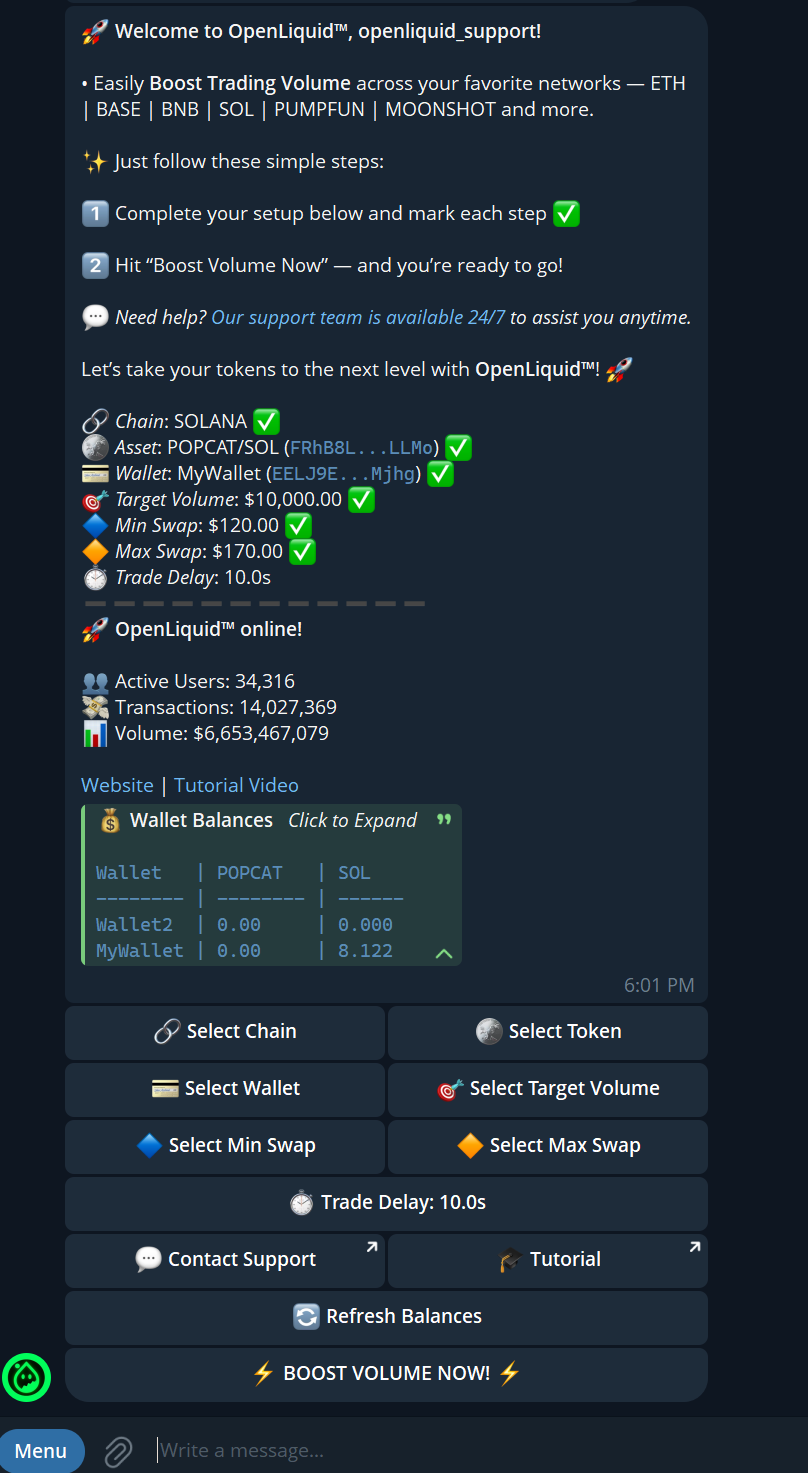
- 2
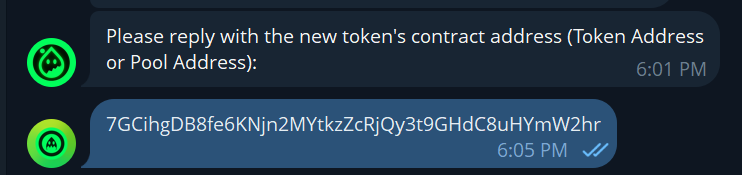
Choose your token (1/2)
Select your chain and paste your token contract address.
- 3
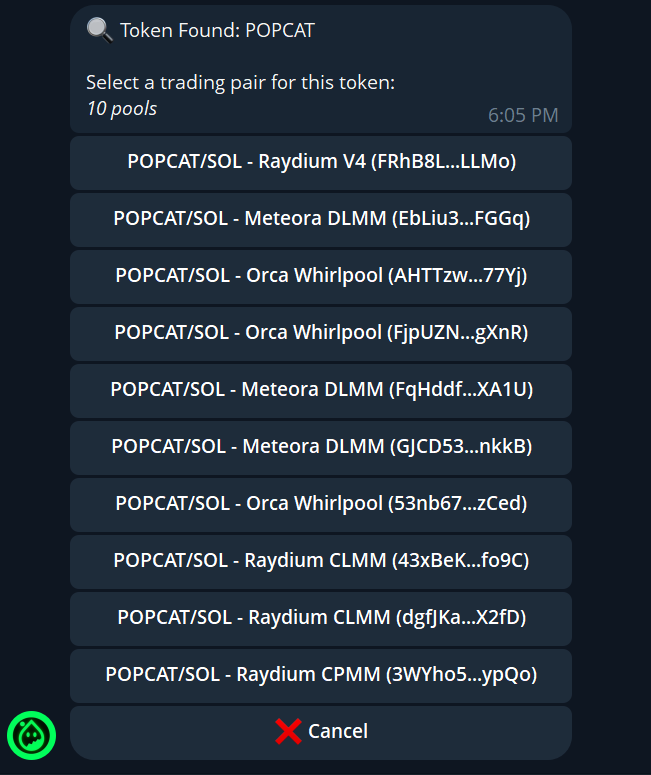
Confirm your token (2/2)
The bot detects your pool — confirm it’s the right token.
- 4
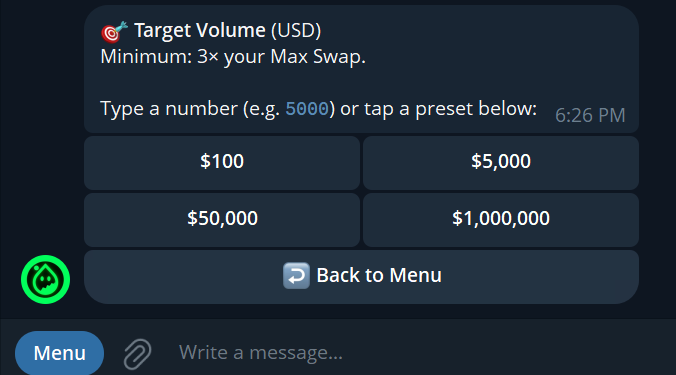
Set your target volume
Choose how much 24h trading volume you want to generate.
- 5
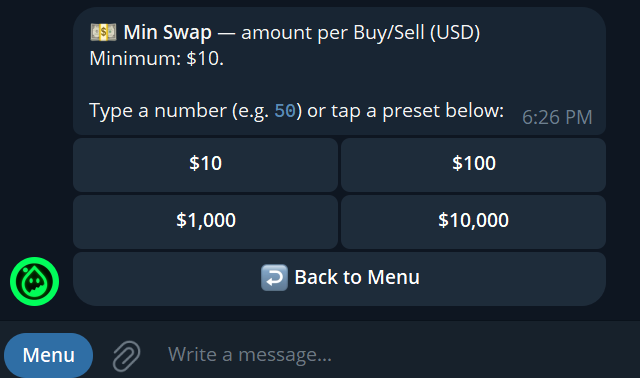
Set minimum swap size
Set the smallest trade size for natural-looking activity.
- 6
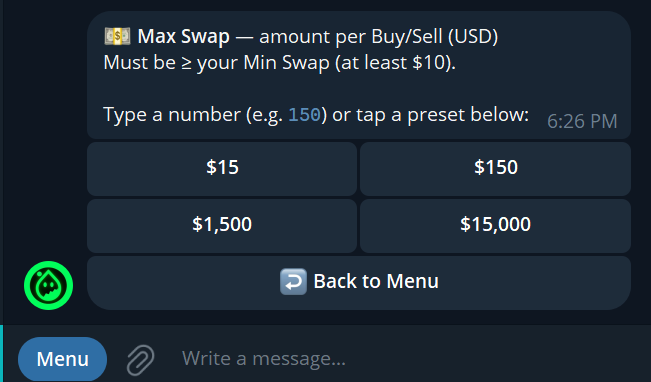
Set maximum swap size
Set the largest trade size — varying it avoids uniform patterns.
- 7
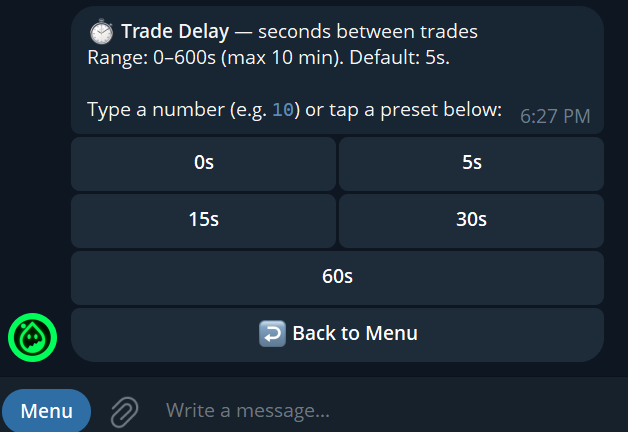
Set delay between trades
Choose the interval between trades, then start your session.
What Is OpenLiquid's Volume Bot?
OpenLiquid's volume bot is a Telegram-based automation tool that generates on-chain trading volume for any token with an active liquidity pool on a supported decentralized exchange. It executes real buy and sell transactions distributed across up to 300 unique wallets (scaled to your target volume), creating organic-looking market activity that helps tokens gain visibility on aggregator platforms like DexScreener, DexTools, CoinGecko, and CoinMarketCap.
Token projects face a fundamental bootstrapping problem. Aggregator platforms rank tokens by trading volume, and traders discover new tokens through trending lists and volume filters. Without sufficient trading activity, a token remains invisible regardless of its fundamentals, community, or utility. OpenLiquid solves this by providing on-demand volume generation that meets the thresholds required for visibility on major crypto data platforms.
The volume bot operates entirely through Telegram. There are no browser extensions to install, no web dashboards to navigate, and no smart contracts to approve. You paste your token contract address, select your target volume, choose your chain, and the bot handles the rest — wallet creation, trade execution, gas management, and real-time reporting all happen automatically within the Telegram interface.
Unlike subscription-based market making services that charge $10,000 to $100,000 per month, OpenLiquid uses a flat 1% fee per session model. Generate $5,000 in volume and pay $50. Generate $50,000 and pay $500. There are no monthly commitments, no minimum contracts, and no hidden fees beyond the 1% and standard blockchain gas costs.
The bot supports 12 blockchain networks and routes through 21 decentralized exchanges, covering the vast majority of active token launches across the crypto ecosystem. Whether your token is on Ethereum mainnet, Solana, Base, BNB Chain, Arbitrum, Avalanche, Polygon, Optimism, Robinhood Chain, or Stable, OpenLiquid can generate volume for it.
How It Works
OpenLiquid's volume bot operates in four stages: session configuration, wallet preparation, trade execution, and real-time reporting. The entire process is managed through Telegram commands, with every trade visible on-chain and reported live in your chat.
Step 1: Session Configuration
You start a session by sending your token's contract address to the OpenLiquid Telegram bot. The bot identifies the chain, available liquidity pools, and current price automatically. You then set your volume target in USD — the total trading volume you want generated during the session. You can optionally configure advanced parameters including trade size ranges, timing distribution, and session duration, though the default settings are optimized for most use cases.
Step 2: Wallet Preparation
Before trade execution begins, the bot prepares a set of fresh wallets for the session. Each wallet is funded with a small amount of the chain's native token for gas and a portion of the session budget. The number of wallets scales with your volume target — larger sessions use more wallets to maintain realistic distribution patterns. Wallet addresses are unique to each session and are not reused across different tokens or clients.
Step 3: Trade Execution
The bot executes a sequence of buy and sell transactions across the prepared wallets. Trade sizes are randomized within a configurable range to avoid uniform transaction patterns. Timing between trades is also randomized — some trades execute seconds apart, others minutes apart, mimicking natural market behavior. Our advanced smart contracts automatically route each trade to the optimal pool for the best price.
Step 4: Real-Time Reporting
Every trade is reported to your Telegram chat as it executes. You see the transaction hash, trade direction (buy or sell), amount, wallet address, and running session totals. At the end of the session, you receive a summary with total volume generated, total trades executed, gas costs, fee breakdown, and links to view the activity on block explorers and aggregators.
Supported Chains
OpenLiquid supports 12 blockchain networks, covering the majority of active token launches and trading activity in the crypto ecosystem.
| Supported Chains |
|---|
| Solana volume bot |
| Base volume bot |
| BNB volume bot |
| Arbitrum volume bot |
| Polygon volume bot |
| Avalanche volume bot |
| Optimism volume bot |
| Ethereum volume bot |
The chain you select impacts your total session cost and speed. Most token projects launching in 2026 choose Solana or Base for volume generation due to the dramatically lower gas costs. OpenLiquid automatically detects which chain your token is deployed on and handles execution for you.
Anti-MEV Protection
Every volume session on OpenLiquid includes built-in anti-MEV protection at no additional cost. Our advanced anti-MEV smart contracts shield every trade from sandwich attacks, front-running, and other forms of MEV extraction that can drain session funds.
MEV — Maximal Extractable Value — refers to the profit that can be extracted by reordering, inserting, or censoring transactions within a block. The most common MEV attack affecting volume bot users is the sandwich attack. In a sandwich attack, a bot detects your pending buy transaction before it confirms, places a buy order immediately before yours (driving up the price), and then places a sell order immediately after yours (capturing the price difference). The result is that you pay more for each buy and receive less for each sell.
Without anti-MEV protection, sandwich attacks can consume 2% to 5% of your session budget on chains with active MEV bots — particularly Ethereum and BNB Chain. On a $10,000 session, that is $200 to $500 lost to MEV extraction on top of your intended costs.
How OpenLiquid Prevents MEV
OpenLiquid's advanced smart contracts submit your transactions directly into the block in a protected, pre-ordered sequence — leaving no opportunity for MEV bots to insert transactions before or after yours.
Across every supported network — Solana, Ethereum, Base, BNB Chain, Arbitrum, Avalanche, Polygon, Optimism, Robinhood Chain, Stable, Monad, and Arc — your transactions stay completely hidden from MEV bots until they confirm, eliminating the visibility they rely on to detect and exploit your trades.
The anti-MEV protection is automatic and requires no configuration. Every trade in every session on every chain is routed through the appropriate protection mechanism. There is no option to disable it because there is no scenario where unprotected execution benefits the user.
Multi-Wallet Rotation
OpenLiquid distributes each volume session across dozens of unique wallet addresses. Multi-wallet rotation is the primary mechanism that makes generated volume appear organic on block explorers and aggregator platforms. Each wallet executes a small number of trades, mimicking the behavior of individual traders rather than a single high-frequency bot.
When a single wallet generates all the volume for a token, the activity is immediately identifiable as artificial. Block explorers show one address dominating the trade history, aggregators may flag the volume as suspicious, and sophisticated traders recognize the pattern and avoid the token. Multi-wallet rotation solves this by fragmenting the activity across many addresses.
How Wallet Rotation Works
At the start of each session, OpenLiquid generates a set of fresh wallets — the number scales with your volume target. A $1,000 session might use 15 to 20 wallets, while a $50,000 session could use 100 or more. Each wallet is funded with a portion of the session budget and a small amount of native token for gas.
During execution, the bot cycles through wallets in a randomized order. Each wallet executes between 3 and 15 trades (the exact number is randomized), then becomes inactive for the remainder of the session. This pattern mirrors how real traders interact with tokens — they buy, possibly trade a few more times, and then hold or move on.
After the session completes, remaining tokens and native gas are consolidated back to your funding wallet. The session wallets are retired and never reused for other tokens or clients, preventing cross-session address linkage.
Why This Matters for DexScreener
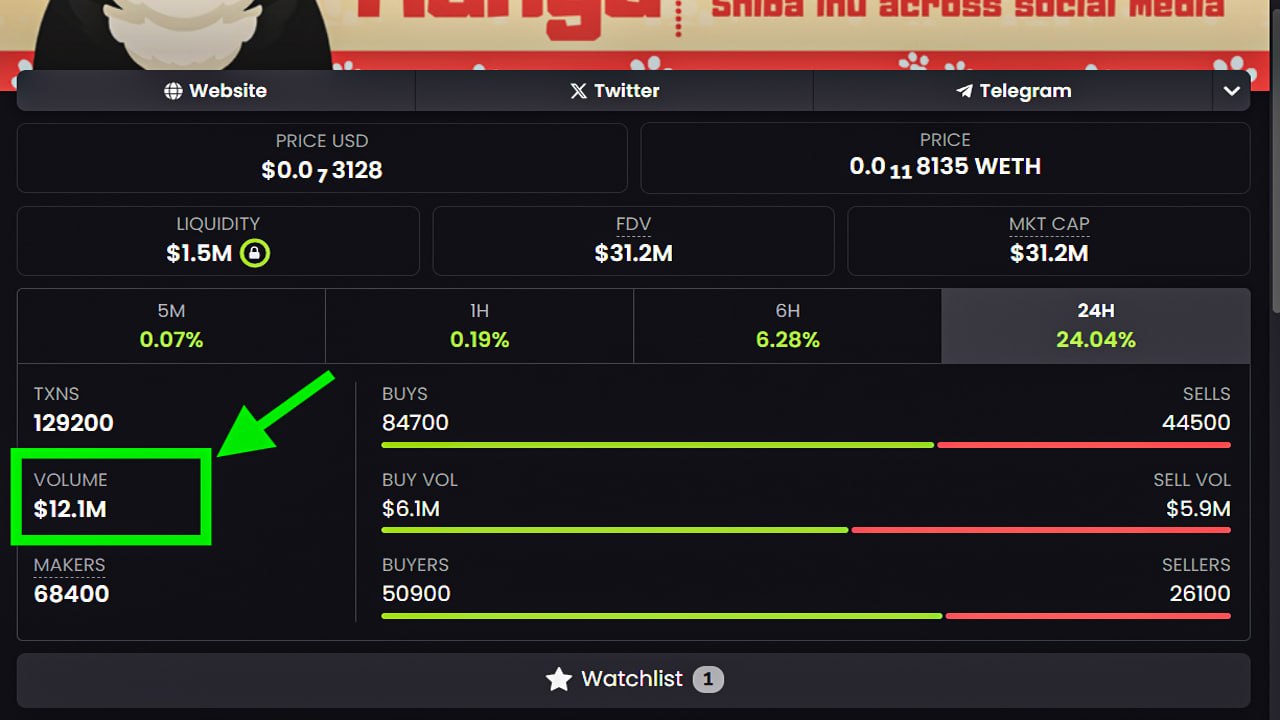
DexScreener and similar aggregators track the number of unique makers (wallets) that trade a token. A token with $10,000 in volume from 50 unique wallets appears far more legitimate than the same volume from 3 wallets. The "Makers" count displayed on DexScreener is directly influenced by wallet diversity, and a higher maker count increases the likelihood that real traders will engage with the token.
DexScreener & DexTools Trending
The primary goal of most volume bot sessions is to achieve visibility on DexScreener and DexTools trending lists. These platforms are the dominant discovery channels for new tokens, and appearing on their trending or "hot pairs" lists can generate thousands of organic page views and new holders within hours.
DexScreener ranks tokens by 24-hour trading volume within each chain category. Tokens that generate sufficient volume relative to other tokens on the same chain appear on the trending page, which is the most-visited section of DexScreener. The exact bar varies by chain and day and shifts constantly with overall market activity.
DexTools uses a similar volume-based ranking but also incorporates additional metrics including holder count, liquidity depth, and social signals. Appearing on DexTools' "Hot Pairs" list provides additional exposure, particularly among European and Asian trading communities where DexTools has a stronger presence than DexScreener.
OpenLiquid's session scheduling feature lets you spread volume across a full 24-hour period rather than generating it all at once, which produces a more natural volume profile on the chart and maintains visibility throughout the day.
Before & After: Real Volume Sessions
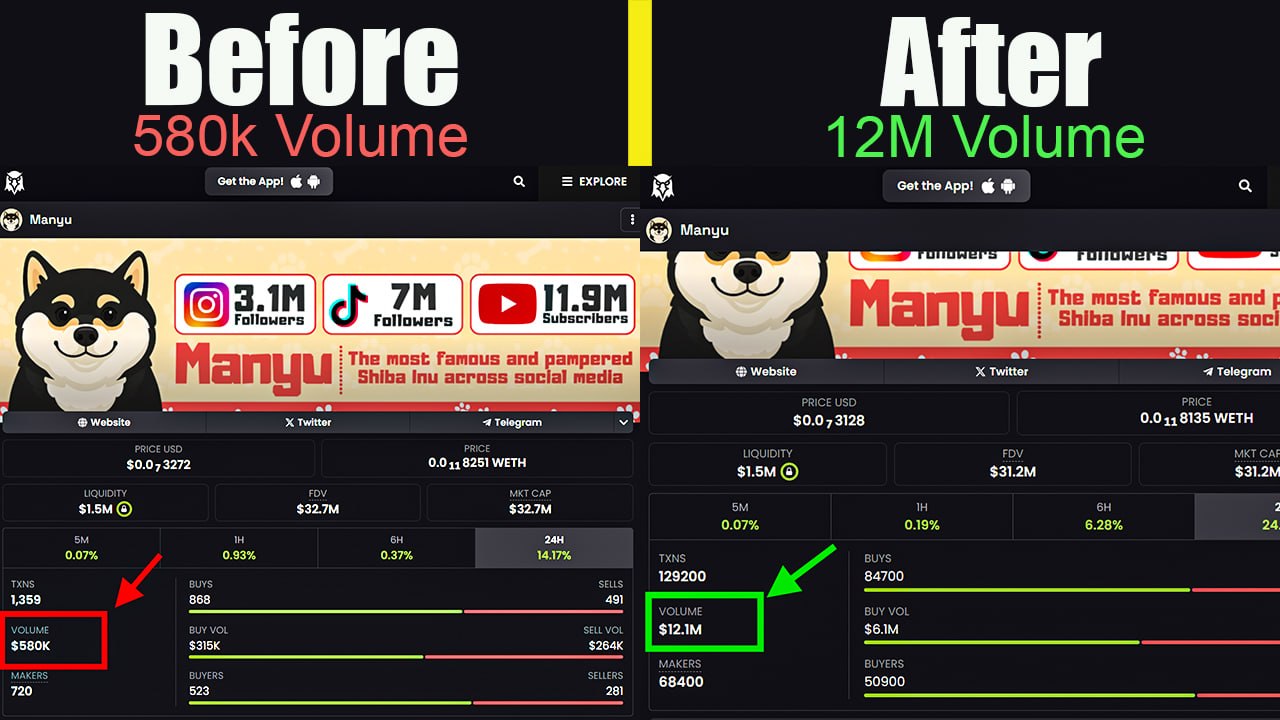
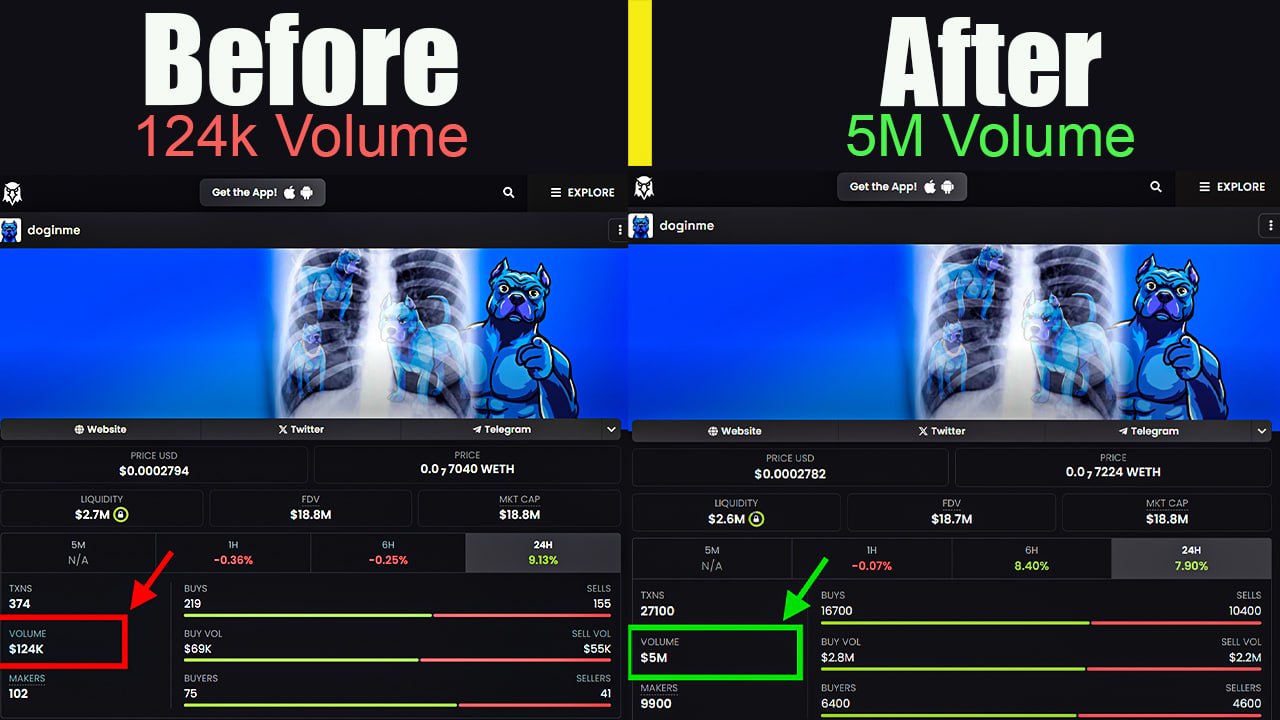
Trading Volume for CoinGecko, CoinMarketCap & DEX Listings
CoinGecko and CoinMarketCap do not publish a fixed dollar volume requirement to get listed. Instead they evaluate whether a token has real liquidity, consistent trading activity, a working market, and genuine holders. Tokens with steady daily volume and healthy liquidity are far more likely to be accepted and ranked with a strong trust score, while thin or dormant markets are commonly rejected or flagged inactive.
Many project owners are told they need "a certain amount of volume" to get listed on CoinGecko. In practice there is no single public number — the real requirement is a consistently active market. Sustained daily volume across a healthy liquidity pool is one of the clearest signals these trackers look for when deciding whether a token represents a legitimate, tradable market.
CoinGecko listing signals
To be tracked on CoinGecko, your token must be trading on a supported exchange or DEX with real liquidity and ongoing activity. CoinGecko reviews for a functioning market: pairs with little or no volume are often rejected or marked inactive, and low activity weakens your Trust Score. A token that shows steady 24-hour volume and stable liquidity presents exactly the activity profile CoinGecko's review process looks for.
CoinMarketCap listing signals
CoinMarketCap weighs liquidity, consistent trading volume, holder distribution, and a verifiable, active market. Like CoinGecko, CMC doesn't publish a fixed threshold, but dormant or thin markets are commonly turned down. Sustained volume signals that your token has an active, real market rather than a stalled pool.
DexScreener & DexTools thresholds
DexScreener and DexTools rank pairs primarily by 24-hour volume and transaction count. Keeping your pair consistently active is what maintains visibility on their trending and "hot pairs" lists — the dominant discovery channels for new tokens.
| Platform | What they evaluate | How OpenLiquid helps |
|---|---|---|
| CoinGecko | Live liquidity, consistent 24h volume, active trades, holders | Sustained multi-wallet volume that keeps your market active |
| CoinMarketCap | Liquidity, consistent volume, holder distribution, real market | Steady volume spread naturally over time |
| DexScreener | 24-hour volume & transactions per pair | Volume that keeps your pair trending and visible |
| DexTools | Volume, holders, liquidity depth, social signals | Consistent activity to reach "Hot Pairs" |
OpenLiquid's volume bot helps your token meet the volume and liquidity signals that CoinGecko, CoinMarketCap, DexScreener, and DexTools look for, generating sustained, organic-looking trading activity across dozens of wallets. It does not guarantee a listing — every platform makes its own review decision — but a consistently active market gives your token the strongest possible case.
2 Options to Boost Your Volume
Pricing
OpenLiquid charges a flat 1% fee per volume session with no subscriptions, no monthly minimums, and no hidden charges. Your total cost is the 1% fee plus blockchain gas costs, which vary by chain. This transparent pricing model makes volume generation accessible to projects of all sizes.
Getting Started
Getting started with OpenLiquid's Done-For-You volume boost takes under five minutes. You fill in a short form, we generate a secure deposit wallet, and our team runs the entire session for you — no bot setup, no wallet management, and no technical steps on your end.
Step 1: Enter Your Token Address
In the Done For You form above, paste your token's contract address (CA) and tap Detect. We automatically identify the token's name, its chain, and every available liquidity pool — so you don't have to look anything up.
Step 2: Choose Your Pool and Targets
Select the pool you want us to trade on, then set your parameters: the minimum and maximum trade size (from $10 per trade), the total volume you want generated, and the time between trades. Everything is guided — no configuration files, no scripts.
Step 3: See the Exact Amount to Send
As you set your target, we instantly calculate the exact amount you need to send to fund the session (minimum order value $50) and show it to you up front — before you commit to anything. What you see is what you pay.
Step 4: Pay Your Way
Place your order and pay directly with your Phantom or MetaMask wallet, or send the amount to the deposit address we generate for you. You have a 30-minute window to complete the deposit, and payment is confirmed on-chain automatically.
Step 5: We Run It and Send Your Receipt
Once your payment lands, our team runs the full volume session for you and reaches out on Telegram. You receive a downloadable receipt with your order reference and transaction so you can track everything — completely hands-off from start to finish.
OpenLiquid's volume bot supports 12 blockchain networks and 21 decentralized exchanges, generating organic-looking trading volume through multi-wallet rotation and randomized trade patterns. The flat 1% fee per session makes it 100x cheaper than traditional market makers charging $10,000-$100,000 per month.
Key Takeaways
- OpenLiquid's volume bot generates on-chain trading volume across 12 chains and 21 DEXs, all operated through a single Telegram bot interface.
- Advanced anti-MEV smart contracts shield every trade from sandwich attacks and front-running so session funds aren't drained.
- Multi-wallet rotation distributes trades across dozens of unique wallets per session, creating organic-looking activity on DexScreener and DexTools.
- Our advanced smart contracts route every trade to the best available pool to minimize slippage and maximize volume generated per dollar spent.
- Flat 1% fee per session with no subscriptions — dramatically cheaper than traditional market making services at $10,000-$100,000 per month.
- Getting started takes under five minutes with no account registration, no KYC, and no software installation beyond Telegram.
Frequently Asked Questions
A crypto volume bot is an automated tool that generates on-chain trading volume for your token by executing buy and sell transactions across multiple wallets on decentralized exchanges. OpenLiquid's volume bot supports 12 chains and 21 DEXs, distributing trades with randomized sizes and timing to create organic-looking activity that helps your token appear on DexScreener and DexTools trending lists.
OpenLiquid charges a flat 1% fee per volume session. If you generate $10,000 in volume, the fee is $100. There are no subscriptions, monthly minimums, or hidden charges. Gas costs vary by chain — Solana costs roughly $0.01 per swap while Ethereum costs approximately $3.50 per swap. Use our volume calculator to estimate total session costs.
OpenLiquid supports 12 blockchain networks: Ethereum, Solana, Base, BNB Chain, Arbitrum, Avalanche, Polygon, Optimism, Robinhood Chain, Stable, Monad, and Arc. Across these chains, the bot routes through 21 DEXs including Uniswap, Raydium, PancakeSwap, Aerodrome, Jupiter, Orca, TraderJoe, SushiSwap, Camelot, and more. Any token with an active liquidity pool on a supported DEX can use the volume bot.
MEV (Maximal Extractable Value) attacks, particularly sandwich attacks, occur when bots detect your pending transaction and place trades before and after it to extract value. OpenLiquid's advanced anti-MEV smart contracts shield your trades from MEV searchers so they cannot be seen or exploited before they execute. This protects your session funds from being drained by front-running bots.
Yes. OpenLiquid distributes trades across dozens of unique wallets per session with randomized trade sizes, randomized timing intervals, and varied wallet addresses. On-chain explorers and aggregators like DexScreener see activity from many different wallets trading at different times for different amounts — which mirrors genuine market activity patterns.
Session duration depends on your volume target and the chain you select. A $5,000 volume session on Solana typically completes in 30 to 60 minutes. On Ethereum, the same session may take longer due to block times and gas optimization. You can monitor every trade in real time directly in your Telegram chat, and you can schedule sessions in advance or set up recurring sessions for consistent volume.
CoinGecko does not publish a fixed dollar volume requirement. To be listed and tracked, your token needs to be trading on a supported exchange or DEX with real liquidity and consistent activity. Pairs with little or no volume are frequently rejected or marked inactive, and low activity weakens your Trust Score. A token showing steady 24-hour volume and stable liquidity presents exactly the active-market signals CoinGecko's review process looks for. OpenLiquid's volume bot helps generate that sustained, organic-looking activity.
CoinMarketCap does not publish a fixed minimum volume, but it evaluates liquidity, consistent trading volume, holder distribution, and whether the token has a verifiable, active market. Dormant or thin markets are commonly turned down. Sustained daily volume signals a legitimate, tradable market rather than a stalled pool, which strengthens a CoinMarketCap listing application.
DexScreener and DexTools rank pairs primarily by 24-hour trading volume and transaction count, and the exact bar shifts constantly with overall market activity. There is no fixed threshold — the goal is to keep your pair consistently active relative to other tokens on the same chain. OpenLiquid distributes volume across dozens of wallets and can spread it across a full 24 hours to maintain visibility on trending and Hot Pairs lists.
A volume bot helps your token meet the volume and liquidity signals that CoinGecko and CoinMarketCap look for by generating sustained, organic-looking trading activity across many wallets. It does not guarantee a listing — every platform makes its own independent review decision — but presenting a consistently active market with healthy liquidity gives your token the strongest possible case for acceptance and a strong trust score.
Start Generating Volume Today
12 chains, 21 DEXs, anti-MEV protection, multi-wallet rotation. Flat 1% fee, no subscriptions. Launch your first session in under five minutes.
Open Volume Bot